
1. Introduction
Political communities periodically experience moments in which the ordinary rhythms of constitutional life give way to extraordinary episodes of transformation. Governments collapse, established institutions lose their legitimacy, and societies seek to redefine the principles upon which public authority should rest. Such moments often appear to contemporaries as decisive breaks with the past: revolutions proclaim new beginnings, reform movements promise renewal, and constitutional transitions aspire to found a more just political order. Yet international law approaches these moments from a markedly different perspective: whereas political transformation is often expressed in the language of rupture, international law is fundamenally built on the presumptionan of continuity.
Classical international law largely avoided this dilemma. For much of its formative development, international law conceived of itself principally as a legal order governing relations among sovereign states rather than the internal organisation of political authority within them. Questions concerning territorial sovereignty, diplomatic intercourse, treaty obligations, maritime navigation, neutrality, and the conduct of war occupied the centre of scholarly attention. Whether a government was monarchical or republican, liberal or authoritarian, revolutionary or conservative generally remained a matter falling within domestic jurisdiction. International law recognised governments because they exercised effective authority over states, not because it sought to evaluate the constitutional foundations of their legitimacy.
This intellectual orientation reflected the historical circumstances in which classical international law developed. The Peace of Westphalia has long served – if sometimes more symbolically than historically – as the point of departure for a legal order founded upon sovereign equality and non-intervention. The Congress of Vienna, despite emerging from the profound upheavals of the Napoleonic Wars, similarly sought not to universalise particular constitutional ideals but to restore international stability through a renewed balance of power. Even the revolutionary movements that swept Europe in 1848 altered comparatively little in the doctrinal architecture of international law itself. Governments rose and fell, dynasties disappeared, constitutions were promulgated and withdrawn – yet the international legal order continued to regard the state, rather than the changing political character of its government, as its principal subject.
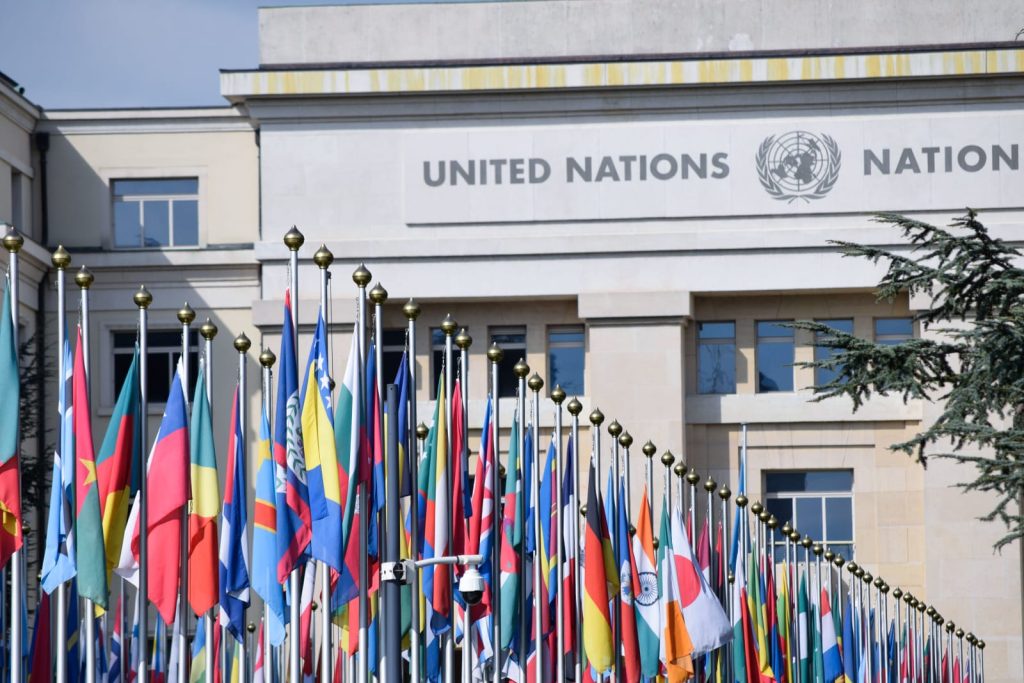
The twentieth century fundamentally transformed this understanding. Two world wars demonstrated with unprecedented clarity that the internal organisation of political authority could no longer be regarded as a matter devoid of international significance. Totalitarianism, aggressive war, genocide, and systematic persecution revealed that the greatest threats to international peace frequently originated not beyond state borders but within them. The establishment of the United Nations therefore represented more than the creation of a new international organisation – it marked the beginning of a profound normative reorientation. Peace was no longer understood exclusively as the absence of interstate conflict – it increasingly depended on respect for human dignity, accountable governance, and the rule of law.
The subsequent development of international human rights law, international humanitarian law, international criminal law, refugee law, and numerous specialised treaty regimes reinforced this transformation. Gradually, international law expanded its field of vision beyond the external conduct of states towards the internal exercise of public authority. Individuals emerged not merely as beneficiaries of diplomatic protection but as holders of internationally recognised rights. States continued to possess sovereignty, yet sovereignty itself increasingly came to be understood as carrying legal responsibilities towards populations as well as privileges vis-à-vis other states.
This transformation has also altered the nature of political transitions. Contemporary constitutional change rarely occurs outside the framework of international law. Governments may change through elections, negotiated settlements, popular uprisings, or revolutionary movements, and constitutions may be amended, suspended, or fundamentally revised – yet the international legal personality of the state ordinarily endures, treaty obligations survive political transformation, membership of international organisations continues, and international responsibility does not disappear with a government’s departure. The legal order therefore assumes a continuity that political actors themselves may not always perceive.
This continuity performs an indispensable stabilising function. It reassures neighbouring states, preserves the reliability of international commitments, protects individuals’ rights, and enables constitutional reconstruction to proceed without dissolving the state’s legal identity. At the same time, continuity cannot become an excuse for preserving institutions that have forfeited their legitimacy through systematic violations of law or fundamental rights. Modern international law therefore inhabits a delicate space between two equally important imperatives – preserving legal order while recognising the legitimacy of constitutional transformation undertaken in pursuit of justice, accountability, and democratic governance.
It is precisely within this dynamic relationship between continuity and change that some of the most important questions of contemporary international law arise. Political transitions do not merely test constitutional arrangements – they also illuminate the evolving relationship between domestic authority and the international legal order. Understanding that relationship requires a closer examination of the concepts of revolution, constitutional change, and international legality. These themes, which have accompanied international legal thought for more than two centuries, form the indispensable theoretical framework for assessing any society undergoing profound political transformation.
2. Revolution, Constitutional Change, and International Legality
If political transformation presents international law with its most persistent practical challenge, revolution presents its most profound theoretical one. Every revolution claims legitimacy by appealing to a higher conception of justice than the legal order it seeks to replace. Law, by contrast, ordinarily derives its authority from continuity rather than disruption. The relationship between revolution and legality has occupied constitutional theorists, political philosophers, and international lawyers for centuries – not because revolutions are rare but because they expose the foundations upon which every legal order ultimately rests.
The apparent opposition between revolution and law is, however, less absolute than it first appears. Political movements seldom reject legality altogether. On the contrary, history demonstrates that revolutionary actors almost invariably seek legal justification for their actions: they invoke constitutional principles, natural rights, popular sovereignty, historical legitimacy, or universal justice precisely because political authority cannot endure on force alone. Even the most radical constitutional transformations have generally been accompanied by an effort to demonstrate that a new legal order represents not the abandonment of legality but its restoration in a higher form. The Glorious Revolution of 1688, the American and French Revolutions, the constitutional reconstruction of post-war Germany and Japan, the negotiated transition from apartheid in South Africa, and the democratic transformations of Central and Eastern Europe all illustrate, in different ways, that revolutions are as much contests over legal legitimacy as they are struggles for political power. This insight has important implications for international law. Classical doctrine generally approached revolutionary change through the principle of effectiveness. Governments were recognised because they exercised stable and effective authority over the state, regardless of the constitutional means by which they had acquired power. Such an approach reflected the discipline’s traditional concern with preserving international stability rather than evaluating domestic political legitimacy. International law recognised states, not ideologies; governments, not political programmes.
The twentieth century gradually complicated this picture. The emergence of the United Nations, the universalisation of human rights, the prohibition of aggressive war, the recognition of self-determination, and the consolidation of international criminal law all contributed to a normative environment in which the internal character of political authority increasingly acquired international relevance. Although international law has never recognised a general right of revolution, neither has it remained indifferent to the values that revolutionary movements often invoke – human dignity, representative government, accountability, and the protection of fundamental rights. As a result, the assessment of political transitions can no longer be reduced to questions of factual control alone. Contemporary legality requires a more nuanced engagement with legitimacy itself.
Yet the relationship between legality and legitimacy remains necessarily complex. Hans Kelsen famously located the validity of a legal order in the effectiveness of its foundational norm, suggesting that a successful revolution ultimately establishes a new legal system by replacing the previous basic norm. Other traditions have placed greater emphasis upon constitutional continuity, institutional memory, or the enduring authority of legal principles that survive political upheaval. Contemporary constitutional theory has increasingly recognised that neither rupture nor continuity adequately captures the dynamics of political transformation. Revolutions rarely erase an existing legal order; equally, they seldom leave it untouched. Instead, they produce intricate combinations of preservation and innovation, continuity and discontinuity, constitutional inheritance and constitutional reinvention. The practical significance of this observation extends far beyond constitutional theory. Every political transition must confront a series of difficult legal questions. Which institutions retain their authority? Which obligations remain binding? Which officials continue to exercise public functions? Which laws survive the transition? How should responsibility for past abuses be addressed? These questions cannot be answered solely by reference to political necessity, nor exclusively through abstract legal doctrine. They require a careful appreciation of both constitutional continuity and constitutional change.
Importantly, continuity should not be mistaken for immobility. International law does not require societies to preserve institutions that have systematically undermined legality itself. Indeed, one defining characteristic of the contemporary international legal order has been its increasing willingness to accommodate constitutional renewal undertaken in pursuit of democracy, accountability, judicial independence, and the protection of fundamental rights. The challenge is therefore not to choose between continuity and change but to determine how legal continuity may provide the framework within which legitimate political transformation can occur without sacrificing either stability or justice.
This balance has become a defining characteristic of modern constitutional transitions. Political communities increasingly seek neither permanent revolution nor unconditional restoration but institutional reconstruction grounded in legality. The language through which this reconstruction is articulated has likewise evolved. Where earlier generations spoke principally of sovereignty and constitutional order, contemporary international law increasingly frames these processes in terms of human dignity, institutional accountability, and individual security. The discussion must now turn to this broader transformation in the conception of security.
3. From State Security to Human Security
Few concepts have transformed the intellectual landscape of international law as profoundly as security. Yet the most important change has not concerned the means by which security is maintained but the object that security is intended to protect. Classical international law understood security primarily as the preservation of sovereign states. The central concerns of diplomacy, alliance formation, collective defence, neutrality, and the regulation of armed conflict reflected an international order in which states constituted both the principal subjects and the principal beneficiaries of legal protection. Individuals appeared within this framework only indirectly, their welfare mediated through the rights and responsibilities of the states to which they belonged. This conception was neither accidental nor irrational. The classical law of nations emerged in an international society characterised by competing sovereigns whose foremost concern was preserving political independence and territorial integrity. Security therefore meant survival of the state. International law sought to reduce the likelihood of interstate conflict by regulating the conduct of governments rather than by examining the condition of the societies they governed. Stability, understood primarily as the absence of war between states, represented the legal order's highest aspiration.
The twentieth century fundamentally challenged this understanding. The catastrophic violence of two world wars demonstrated that the gravest threats to international peace frequently originated within states rather than between them. Genocide, crimes against humanity, systematic political persecution, forced displacement, and widespread violations of fundamental rights revealed an uncomfortable truth: the security of states could coexist with profound insecurity for their populations. Indeed, some of the strongest and most centralised states in history proved capable of inflicting the greatest suffering upon those living under their authority. International law could no longer remain indifferent to the internal exercise of public power without neglecting the very values upon which durable international peace depended.
The Charter of the United Nations initiated this transformation but it did not complete it. During the decades that followed, an increasingly interconnected body of international norms gradually reshaped the discipline’s understanding of security. The Universal Declaration of Human Rights and the subsequent human rights treaties recognised individuals as direct holders of internationally protected rights. International humanitarian law expanded protection for civilians during armed conflict. International refugee law acknowledged that the collapse of domestic protection might itself generate international legal obligations. International criminal law affirmed that certain violations were so grave that responsibility attached directly to individuals, irrespective of official position or domestic authorisation. Collectively, these developments reflected a profound normative reorientation: preserving international peace became inseparable from protecting human dignity.
The emergence of the concept of human security during the final decade of the twentieth century did not create this transformation so much as give it a coherent intellectual vocabulary. First articulated systematically in the 1994 Human Development Report of the United Nations Development Programme (UNDP), the concept challenged the assumption that security could be measured exclusively by military capability or geopolitical stability. Instead, it proposed that genuine security must also encompass freedom from fear, freedom from want, and the conditions necessary for individuals to lead lives of dignity and opportunity. Subsequent debates within the United Nations refined this understanding, emphasising that security should be understood as people-centred, comprehensive, preventive, and attentive to the interdependence of peace, development, human rights, and good governance.
The significance of this conceptual shift extends well beyond terminology. Human security does not displace state security, nor does it diminish the continuing importance of sovereignty within the international legal order. Rather, it redefines sovereignty itself. Increasingly, sovereignty is understood not simply as authority exercised over territory but as responsibility exercised towards populations. States remain indispensable institutions of international law precisely because they provide the legal and institutional framework within which the rights, freedoms, and welfare of individuals may be realised. The legitimacy of public authority is therefore measured not only by its effectiveness in maintaining order but also by its capacity to protect those who live under its jurisdiction.
This evolution has also transformed the understanding of international peace and security. Contemporary threats rarely present themselves in the conventional form of interstate military confrontation alone. Fragile institutions, systemic corruption, erosion of judicial independence, democratic backsliding, mass displacement, environmental degradation, public health emergencies, cyber vulnerabilities, and widening social inequalities increasingly possess both domestic and international consequences. The distinction between internal governance and international stability has become progressively more difficult to sustain. States’ resilience now depends as much on the integrity of their institutions as on the strength of their armed forces.
For international lawyers, this development carries an important methodological implication. Questions that might once have been regarded as matters of domestic constitutional organisation now occupy a central place within international legal analysis. Judicial independence, accountability mechanisms, the protection of minorities, the functioning of representative institutions, and the prevention of impunity are no longer merely constitutional concerns – they increasingly constitute elements of a broader international legal architecture designed to preserve peace through justice rather than stability alone. This transformation provides the indispensable context for understanding contemporary political transitions. Where earlier generations of international lawyers might have regarded constitutional reform principally as an internal matter, today’s legal order recognises that the quality of public institutions, the protection of fundamental rights, and the accountability of those exercising political authority possess significance extending well beyond national borders. Political transformation therefore raises not only questions of constitutional design but also questions of international responsibility. Increasingly, these responsibilities are articulated through a common normative language – one that places accountability at the centre of contemporary international law.
4. Accountability as the Constitutional Language of the International Community
If the second half of the twentieth century witnessed the gradual humanisation of international law, the opening decades of the twenty-first have been characterised by the remarkable expansion of another normative idea – accountability. Few concepts have acquired comparable influence across so many branches of international law. Once associated principally with diplomatic responsibility and the legal consequences of internationally wrongful acts, accountability has evolved into a broader constitutional principle governing the legitimate exercise of public authority. Today it informs international criminal law, international human rights law, transitional justice, anti-corruption regimes, international humanitarian law, environmental governance, global financial regulation, and the practice of numerous international organisations. Although these fields differ in their institutional structures and legal techniques, they increasingly share a common normative premise – the exercise of public power must remain answerable to law.
This development reflects a deeper transformation in the international community’s constitutional imagination. Classical international law was principally concerned with delimiting competences among sovereign states, and contemporary international law continues to perform that function. Still, it increasingly asks an additional question: not merely who possesses authority but how that authority is exercised and by what standards it should ultimately be judged. Accountability therefore operates not simply as an instrument of legal enforcement but as a principle of constitutional legitimacy. It embodies the expectation that public institutions remain subject to independent scrutiny, that violations of fundamental norms give rise to legal consequences, and that governmental authority derives its durability not only from effectiveness but also from fidelity to law.
This transformation is perhaps most visible in the remarkable development of international criminal justice. The Nuremberg and Tokyo Tribunals established the revolutionary proposition that individuals acting on behalf of states could incur direct responsibility under international law. For several decades, however, these proceedings appeared to many observers as exceptional responses to exceptional circumstances. The revival of international criminal justice after the Cold War, through the establishment of the International Criminal Tribunals for the former Yugoslavia and Rwanda, followed by the creation of the International Criminal Court, fundamentally altered that perception. Individual criminal accountability became embedded within the architecture of the international legal order as a permanent, rather than episodic, aspiration.
Yet accountability extends well beyond criminal punishment. Contemporary international law increasingly recognises that justice after periods of political violence or authoritarian rule cannot be achieved through prosecutions alone. Truth-seeking mechanisms, reparations programmes, institutional reform, constitutional guarantees of non-recurrence, judicial independence, and public memorialisation have become integral components of what is now commonly understood as transitional justice. The field itself has evolved from a relatively narrow concern with responding to past abuses into a broader framework for understanding how societies reconstruct legitimacy after profound political disruption. In this sense, accountability has become simultaneously retrospective and prospective. It addresses past violations while seeking to establish institutional conditions that reduce the likelihood of their recurrence.
The same evolution is evident across other domains of international law. Human rights bodies increasingly require states not merely to refrain from violating protected rights but also to investigate abuses effectively, prosecute those responsible where appropriate, provide meaningful remedies to victims, and undertake structural reforms addressing systemic deficiencies. International humanitarian law similarly links compliance with obligations to investigate and repress serious violations. International anti-corruption instruments increasingly emphasise institutional transparency and the integrity of public administration. Even international environmental law, long regarded as primarily regulatory, now places growing emphasis on monitoring, reporting, transparency, and review mechanisms that make governmental conduct more visible and more answerable to international standards.
These diverse developments should not be viewed as isolated doctrinal innovations. Together they reveal a broader constitutional movement within international law itself. Increasingly, legality is understood not as a static condition but as a continuing process through which public authority remains subject to legal evaluation. Accountability thus functions as the mechanism through which the rule of law acquires practical meaning. It links rights to remedies, obligations to consequences, authority to responsibility, and institutional power to public trust.
At the same time, accountability should not be mistaken for retribution. One enduring lesson of comparative experience is that sustainable political transitions require a careful balance between justice and reconciliation, legal responsibility and institutional stability, memory and future-oriented reform. Excessive impunity undermines confidence in the rule of law; excessive legalism may impede the political compromises upon which peaceful transitions occasionally depend. International law therefore resists rigid formulae. It does not prescribe a single institutional model applicable to every society emerging from conflict or authoritarianism. Instead, it establishes a framework of principles within which states retain a measure of discretion while remaining bound by fundamental obligations concerning truth, justice, reparations, and guarantees of non-repetition. This nuanced understanding explains why contemporary transitional justice increasingly emphasises accountability as a comprehensive process of constitutional reconstruction rather than merely punishing individual offenders.
It is equally important to recognise that accountability is not directed solely towards governments that have relinquished power. Political transition does not extinguish international obligations – it redistributes responsibility for fulfilling them. Newly established authorities inherit not only the state’s institutional apparatus but also the legal duty to investigate past violations, protect fundamental rights, restore public confidence in legal institutions, and strengthen the constitutional safeguards needed to prevent future abuses. In this respect, accountability bridges past injustice and future legitimacy. It enables societies to confront historical grievances without becoming imprisoned by them.
For international lawyers, this evolution carries a broader significance. Accountability increasingly performs a function analogous to that of constitutionalism within domestic legal systems. It does not replace sovereignty, nor does it diminish the continuing importance of state consent as the foundation of international legal obligation. Rather, it gives substantive expression to the contemporary understanding that sovereignty is exercised within a legal order whose legitimacy depends upon respect for human dignity, the rule of law, and institutional responsibility. One might therefore describe accountability as the constitutional language through which the international community articulates its expectations of lawful governance.
5. Conclusion: Bangladesh in Comparative Perspective and the Role of Scholarship
Every political transition possesses its own historical, constitutional, and cultural particularities; no revolution precisely resembles another. Yet across different regions and historical periods, societies undergoing profound political transformation repeatedly confront remarkably similar legal questions. They must determine how public institutions can recover legitimacy after prolonged crisis, how responsibility for past violations can be reconciled with the imperative of future stability, and which constitutional structures are capable of preventing the recurrence of authoritarianism while preserving democratic governability.
Bangladesh belongs firmly within this broader comparative tradition. The historic events of June–August 2024 and the subsequent period of constitutional and institutional reform cannot be understood solely through the categories of domestic politics. Rather, they illuminate larger developments within the contemporary international legal order. As one of the world’s largest constitutional democracies, an increasingly influential voice in the Indo-Pacific, and a prominent contributor to United Nations peacekeeping, Bangladesh’s constitutional evolution has implications that extend far beyond its national borders. Its recent experience serves as a vital case study, engaging the defining questions of twenty-first-century constitutional governance: reconciling institutional continuity, accountability, human rights protection, and democratic legitimacy.
Navigating these complex transitions highlights the distinctive responsibility of academic scholarship. During periods of profound political transformation, the legal community is presented with an unusual dilemma: analysing events whose legal consequences continue to unfold. In this environment, rigorous scholarship must resist two equal but opposite temptations—the temptation of premature certainty, which assumes definitive answers before institutional processes have matured, and the temptation of excessive detachment, which avoids engaging with difficult normative questions altogether.
The true task of the scholar is not to predict the future or pronounce definitive political judgments before history has rendered its verdict, but to distinguish enduring legal principles from immediate political controversies. By identifying the core questions concerning accountability, institutional reform, human security, and constitutional resilience, legal scholarship performs an indispensable function: it creates the intellectual vocabulary through which future generations will understand the legal significance of their own history. In this respect, Bangladesh's ongoing transition offers a rare and critical opportunity to test, refine, and rethink the foundational assumptions that guide the international legal community’s understanding of democratic reconstruction and the rule of law.
About the author
Professor Sergey Sayapin, Dr. iur.
Professor of International Law, KIMEP University, Kazakhstan
Full profile and articles