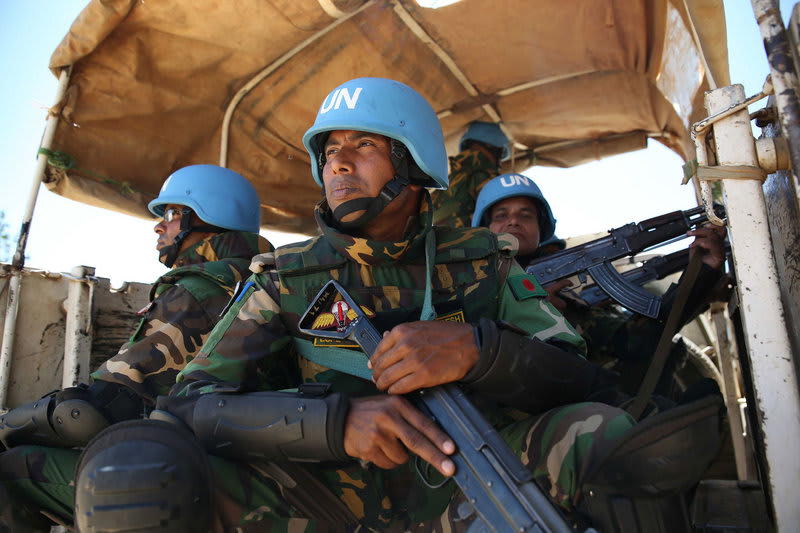
In March 2025, Volker Turk, the United Nations High Commissioner for Human Rights (OHCHR), said in a BBC program that the United Nations had warned the Bangladesh Army that its involvement in suppressing the student-led protests against the regime during the July Revolution of 2024 could lead to their removal from UN peacekeeping missions. In reply, the Inter Services Public Relation Directorate (ISPR) of the Armed Forces of Bangladesh released a statement clarifying that the Bangladesh Army leadership did not receive any direct communication from the OHCHR regarding the issue. The statement further indicated that if any communications had been made, it may have been conveyed to the Government of Bangladesh and that the remarks taken out of context had contributed to the misrepresentation of the role of the Bangladesh Army. Although no further information regarding the truth (or falsehood) of the event has been discovered, the remarks of Volker Turk possess an intriguing insight into the role of the UN during an ongoing crisis. The statements were made in reply to a question regarding the role of the UN in resolving crises under international law. As of February 2025, Bangladesh is the third largest contributor to the UN Peacekeeping operations, and being removed from it would have greatly tarnished the reputation of the Bangladesh Army globally. Whether the warning of the UN played a part in the July Revolution and helped topple the regime in Bangladesh last year remains open for speculation. However, the legality and legal implications of such a warning should be explored.
Article 43 of the UN Charter obliges all members to make available their armed forces, assistance, and facilities to the Security Council to maintain international peace and security. Furthermore, mandates from the UN Security Council, which are assigned on the basis of the nature of the conflict and ever-changing threats to international peace and security, provide the legal validity for the UN Peacekeeping missions. The contribution of troops or other assistance under this provision shall take place through special agreement(s), which will be negotiated at the initiative of the Security Council. Several resolutions of the Security Council and the General Assembly further provide for different requirements regarding the participation of countries in the missions. For example, the Security Council Resolution 2436 (2018) focuses on the performance and accountability of the peacekeeping troops, taking a strong stance against sexual exploitation and abuse within the peacekeeping operations. The United Nations Department of Peace Operations (DPO) is the UN department that is charged with the management of all peacekeeping operations. The DPO has issued official guidelines and standards for troop and police contributions. UN Peacekeeping Operations: Principles and Guidelines is one of these documents that defines the basic principles of peacekeeping and the factors of success, none of which mentions the role of the Armed Forces in domestic issues. Failure to maintain integrity and a prohibitive degree of force could be grounds for suspension or removal. However, such actions should be taken during the mission and in the country where the mission is deployed.
In the apparent absence of any explicit texts in the documents mentioned, the grounds that can be presumed to result in discontinuance of a country from future peacekeeping missions, could be (i) having any interest adverse to the goals of the mission, (ii) non-compliance with any resolutions of the UN, (iii) failure to fulfill its financial obligations, and (iv) failure to uphold the principles of the UN Charter. Nothing in these documents explicitly indicates that engagement or allegation of human rights violations in domestic issues could lead to suspension or removal of a troop in an ongoing mission. But, there is a possibility for such suspension or removal, if the UN Security Council mandates provide for any such limitation.
Again, seeing that the mandate of peacekeeping missions is to maintain international peace, any armed forces engaged or having an allegation of human rights violations in their own country cannot be morally qualified to be part of the peacekeeping missions. Engagement in peacekeeping missions usually requires a special agreement between the UN and the troop-contributing country to be negotiated on the initiative of the Security Council. The agreement usually governs the number and types of forces to be contributed, their degree of readiness, the nature of the facilities and assistance, etc. It is possible for the UN to insert clauses in the agreement that require individuals participating in the mission to have no records or allegations of human rights violations, and also, the forces to be part of the mission have no allegations of human rights violations. The United Nations Policy: Human Rights Screening of United Nations Personnel (2012) already provides for a vetting process for personnel nominated to join the United Nations. However, an alleged defect in the process is that it is usually for the governments of the member states to vet the personnel, and if the individuals are complicit with the government itself in human rights violations, then the vetting does not become a barrier to their participation in peacekeeping missions. The clause could further provide it as a requirement that participating forces have a continued record of clean hands in human rights-related issues at home and abroad.
Since there is no explicit mention of such ground anywhere in the rules and regulations of the UN surrounding peacekeeping missions, immediate and full suspension of forces during the mission's continuance might require the Security Council's approval. And it is no secret that decision-making in the Security Council is heavily politicized. However, even in the absence of any explicit bar, involvement of an armed force in human rights violations back home can become grounds for increased scrutiny for future involvement in peacekeeping missions. The United Nations is expected to be greatly discouraged from engaging such forces in future peacekeeping missions.
Over the decades, Bangladesh has strengthened its global reputation through its effective participation in UN peacekeeping missions. It would be a great loss for the armed forces of Bangladesh and the country in general if its participation in the peacekeeping missions is threatened for any reason. Although it is expected that the UN will play a more effective role in dealing with international crises, if the comments made by Volker Turk are indeed true, it might be represented as an impulsive decision. The Peacekeeping missions have heavy contributions from the Global South, with only one of the top 20 contributing countries of the missions belonging to the Global North. The contribution of the Global South has been pivotal for the peacekeeping missions, and the hurried, impulsive suspension of any force from the missions will harm not only the country but the missions as well. While Article 94 of the UN Charter implements the decisions of the International Court of Justice dependable on the recourse to the Security Council, suspension from peacekeeping missions must not be made by a mere impulsive unilateral executive order.
That being said, scrutiny in the peacekeeping missions should be increased. First, clauses in the special agreements should guarantee the continued clean hands of the armed forces and their personnel in human rights matters at home and abroad. The special agreements with the states are perhaps the most efficient mechanism to keep in check all sorts of human rights violations in a peacekeeping machine and also a force’s human rights compliance in its own soil. Secondly, the vetting process of the individuals who will participate in the missions should be more stringent, with added vetting by UN officials after national government vetting. There have been some improvements, as there is now a policy for DPO to approach OHCHR for the appointment of senior-level positions. Still, the UN lacks the will and resources to vet every participant of a peacekeeping machine.
About the author
Lecturer, Chittagong Independent University
Arafat Ibnul Bashar is a Commonwealth Shared Scholar who obtained an LL.M. in Human Rights from the University of Glasgow (UK). Arafat has obtained his LL.B. (Hons) and LL.M. from the University of Chittagong, and a Diploma in ESDR from Kathmandu School of Law (Nepal). With over three years of teaching experience, he is currently…
Full profile and articles