INTRODUCTION
“War criminals will not survive from the hands of law. Pakistani military personnel who were involved with killing and raping have to face tribunal,”
declared the Home Minister of Bangladesh A. H. M. Qamaruzzaman on December 24th, 1971, following the nine-month Liberation War during which millions of Bengalis in West Pakistan were killed, raped, and displaced. The Liberation War was sparked by the 1970 election in Pakistan, in which the Awami League (AL), a political party based in East Pakistan, won a majority of seats in the National Assembly. This result was not implemented by West Pakistan, which had been treating the eastern wing of the country as a “virtual internal colony”. This led to a countrywide Bengali secessionist movement beginning in March 1971. Massive demonstrations from AL supporters were violently repressed by a brutal East Pakistani military operation. From March 1971 to December 1971, members and supporters of the AL, intellectuals, Bengali personnel of armed forces and paramilitary units, and the Hindu population were the targets of the genocide. Students were shot down in universities, women were subjected to systematic rape, and Bengali intellectuals were deliberately targeted and executed. In total, Bangladeshi authorities claim that three million people were killed, and 200,000 women were raped.
Yet, the officers and soldiers of the Pakistani army who committed these unspeakable acts have never been held accountable. In the 54 years since its independence, Bangladesh has never obtained full recognition of the widespread human rights violations committed by the Pakistani army during the 1971 war, despite Dhaka’s repeated requests for official acknowledgment. How can this persistent lack of accountability be explained, despite the apparent availability of multiple legal avenues — ranging from state responsibility and individual responsibility to questions of jurisdiction and extradition? This article argues that Pakistan’s impunity is the result of a combination of political compromise, legal constraints, and geopolitical considerations that, taken together, effectively neutralised all meaningful avenues for prosecution.
POLITICAL COMPROMISE AND DIPLOMATIC TRADE-OFFS AFTER 1971: The 1974 Tripartite Agreement
Following India’s military intervention in Bangladesh in late 1971, and Pakistan’s surrender to the Indian army, 93,000 Pakistani prisoners of war were moved to India. India and Bangladesh together identified 195 members of the Pakistani army as the main criminals to be tried for war crimes. Bangladesh also affirmed that there was a “universal consensus” that such individuals should be held accountable through due process.
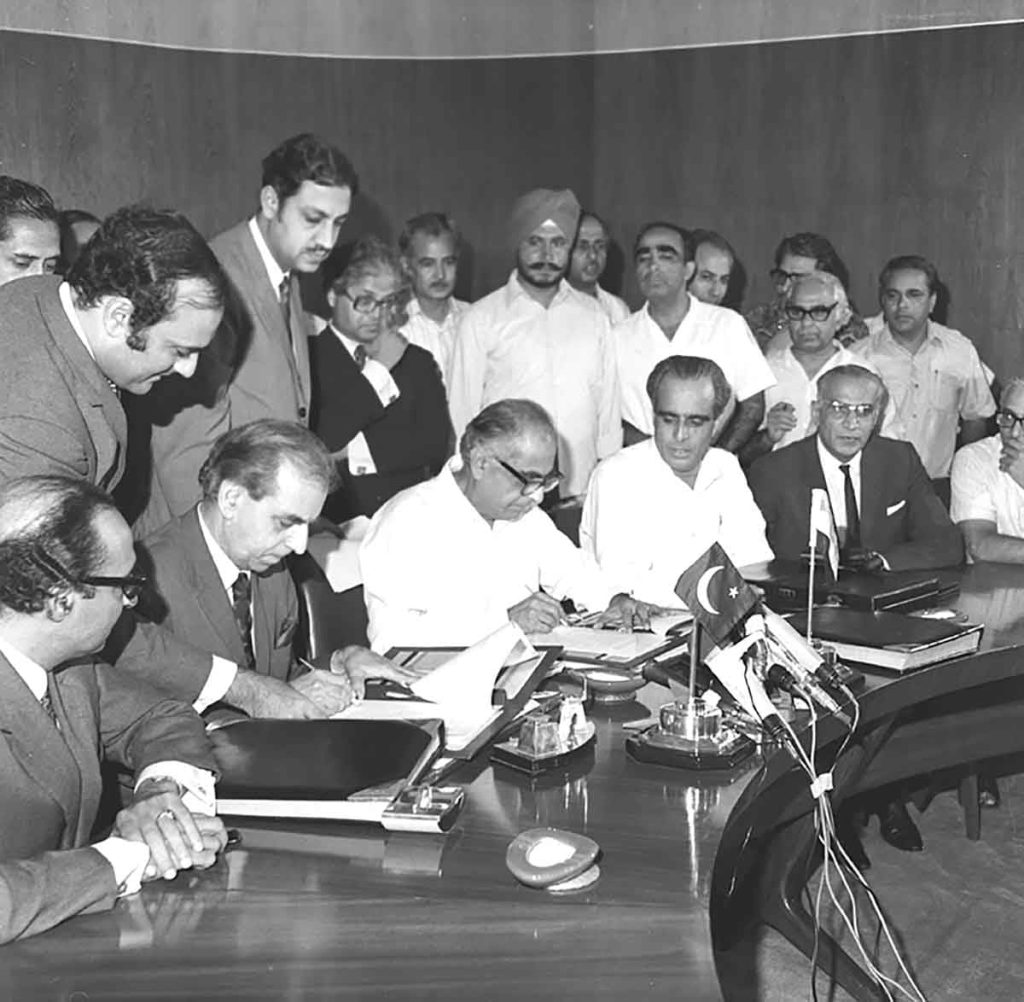
However, in 1974, a tripartite pact, the Delhi Agreement, was signed between Bangladesh, India, and Pakistan, emphasizing reconciliation, peace, and friendship. Bangladesh’s initial intention to prosecute the 195 Pakistani prisoners of war was undermined by significant political pressure. Pakistan threatened to prosecute the 400,000 stranded Bengalis in West Pakistan for treason should trials proceed against Pakistani military personnel.
Faced with this coercive pressure, Bangladesh ultimately declared that it would not proceed with the trials “as an act of clemency.” In exchange, Pakistan agreed to the repatriation of Bangladeshi civilians and military personnel detained on its territory.
In practice, this arrangement resulted in the repatriation of the 195 suspected war criminals from Indian custody to Pakistan. This transfer had decisive legal consequences: it removed the accused from the jurisdiction of Bangladesh, the territorial state where the crimes had been committed, and thereby eliminated any realistic prospect of prosecution.
Although the agreement implicitly relied on the assurance that Pakistan would undertake domestic prosecutions, no such tribunal was ever established. As a result, what was formally presented as a humanitarian and diplomatic compromise effectively operated as a de facto political amnesty for individuals suspected of having committed international crimes.
Diplomatic Considerations: Bangladesh’s Struggle for Recognition
In 1974, Bangladesh was a new state that needed recognition. As noted by Professor Bass, unlike the clear-cut military victory in World War II, Bangladesh’s 1971 victory was not decisive enough to enable the victors to prosecute the defeated for war crimes. It was therefore not an option for Bangladesh’s government to request that Pakistani military personnel responsible for war crimes be tried in Bangladesh. On the contrary, Bangladesh needed to stay in Pakistan’s good graces in order to gain international recognition as a state. Because of Pakistan’s diplomatic links and influence, especially among Muslim-majority states, Bangladesh first needed recognition from Pakistan, in order to receive recognition from many other states, and to be able to participate in international forums such as the United Nations General Assembly and the Organisation of Islamic Countries.
Moreover, as part of the Tripartite Agreement between India, Pakistan, and Bangladesh, both the Prime Ministers of Pakistan and Bangladesh declared that the people of Bangladesh should forgive and forget the past to promote reconciliation. This reflects how Bangladesh’s political interests – gaining recognition as a sovereign state – prevailed over the pursuit of justice for the 1971 atrocities. Consequently, Bangladesh abandoned efforts to prosecute Pakistani war criminals, largely due to Pakistan’s reluctance to hold the trials, as well as its persistent denial of the nature and scale of the crimes committed during the Liberation War.
PAKISTAN’S DENIAL OF THE GENOCIDE: Official Denial of the 1971 Crimes
Pakistan has consistently refused to recognise the widespread crimes it perpetrated in Bangladesh in 1971. As Ratul (2024) notes, there is a “persistent denial of Pakistan regarding the 1971 atrocities”. The government not only maintains an official stance of denial but also pressures Pakistani media to refute the crimes. It has even produced books and articles distorting historical facts about the Bangladesh Liberation War. This general denial is still prevalent today, as recent statements by Pakistan continue to refuse to acknowledge the 1971 atrocities.
While part of the Pakistani population completely denies the abuses committed by the Pakistani army in Bangladesh (Ratul, 2024), another part justifies these crimes with fallacious arguments. For instance, they point to the fact that Bengalis targeted Biharis – non-Bengali citizens of the former East Pakistan – for their support of West Pakistan in the Liberation War. Although not false, this fact cannot in any way serve as a justification for the mass atrocities committed by the Pakistani army.
No Truth, No Trial: The Absence of Domestic Legal Action
Because of the general denial of the genocide, there has been a lack of political will to prosecute the war criminals of 1971. No special tribunal was ever set up in Pakistan, nor were the criminals prosecuted before regular Pakistani courts. This lack of will to prosecute goes so far as to include the hiding of a crucial report by Justice Hamoodur Rahman on the responsibility of the Pakistani military in 1971. Justice Hamoodur Rahman, the only Bengali judge who remained in Pakistan after 1971, was appointed by the Pakistani government to investigate the military failure that led to the creation of Bangladesh. His 1975 report went far beyond its original mandate, holding both the military and political leadership, including Bhutto, responsible for atrocities such as mass killings, rape, looting, and misconduct by army officers in East Pakistan. Though the commission recommended court martials, no action followed, and the report went missing, only to be leaked in the media 25 years later. This concealment of information by Pakistan's political class and the silencing of voices demanding accountability have effectively prevented any trials from taking place in Pakistan concerning the 1971 events.
INTERNATIONAL SILENCE: Cold War Alliances and the United Nations’ Reluctance to Act
International criminal law clearly prohibits genocide, war crimes, and crimes against humanity. While genocide is now codified in Article 6 of the Rome Statute of the International Criminal Court, the prohibition already existed in binding form under the 1948 Genocide Convention at the time of the events. That Convention imposes an obligation on States not only to prevent but also to punish genocide.
Crimes against humanity, although codified later in instruments such as Article 7 of the Rome Statute, were already firmly established under customary international law, notably since the Nuremberg Trials. These crimes entail individual criminal responsibility and do not depend on the existence of an armed conflict. Crucially, their prohibition is widely recognised as a jus cogens norm, giving rise to obligations erga omnes, including duties to prosecute or extradite perpetrators.
Under this legal framework, individuals accused of genocide or crimes against humanity should have been prosecuted either by Bangladesh or before an international tribunal. In the absence of effective domestic proceedings in either Bangladesh or Pakistan, the establishment of an international tribunal would have constituted the most coherent and legally consistent solution.
In 1972, Sheikh Mujibur Rahman, the leader of the Awami League, sought the help of the United Nations (UN) to establish an international tribunal and to proceed with trials. The UN did not answer favourably, and instead suggested that Bangladesh set up its own tribunal with a neutral team to prosecute and try the Pakistani prisoners of war – which, as explained above, was not a viable option because of the threats and pressures put by Pakistan on Bangladesh.
This reluctance on the part of the UN can be explained by the Cold War geopolitical context. Pakistan was a crucial ally of the United States (U.S.) in the Cold War. The U.S. government, prioritising geopolitical interests over addressing atrocities committed by Pakistan, therefore had no interest in agreeing to assist Bangladesh’s trials. Although India, Russia, and Poland supported Bangladesh, they did not take any initiative to hold Pakistan accountable. International alignments during the Cold War completely blocked discussions on genocide in Bangladesh at the UN, making any assistance for the trials inconceivable.
Limits to Domestic Prosecution at the ICT-BD: Territorial Jurisdiction and Pakistan’s Refusal to Extradite
The impossibility of setting up an international tribunal left Bangladesh with no choice but to create its own domestic tribunal to address the 1971 atrocities. The International Crimes Tribunal Bangladesh (ICT-BD) was established under the International Crimes (Tribunals) Act of 1973. While the ICT-BD’s subject matter and personal jurisdiction resembled those of the Nuremberg tribunal, it was established as a domestic tribunal, according to domestic laws. Although it was attributed jurisdiction over perpetrators of crimes during the Liberation War – a category naturally encompassing Pakistani military personnel who committed crimes – the latter cannot fall within the ICT-BD’s scope of jurisdiction due to the principle of territoriality of domestic law. Territorial jurisdiction means that Bangladesh can only enforce its law on people who are physically present on its territory, or people who have been extradited to Bangladesh by another state. Despite demands from Bangladesh, Pakistan never agreed to extradite its nationals to face trial in Bangladesh.
The ICT-BD, therefore, focused on prosecuting the Bangladeshi collaborators of the Pakistani military forces, who assisted Pakistani military personnel in committing crimes during the war, while the Pakistani soldiers and officers, the principal perpetrators of the 1971 atrocities, remained beyond the reach not only of the ICT-BD but of any court.
Universal Jurisdiction: A Realistic Path?
Although historical opportunities for prosecution were lost, impunity is not necessarily irreversible. Contemporary developments in international criminal law, particularly the expansion of universal jurisdiction, suggest that accountability could still be pursued today.
The erga omnes character of obligations to prosecute genocide and crimes against humanity implies that third states were not merely entitled but arguably required to take action where territorial and national jurisdictions failed. A number of States, such as Germany, France, and the Netherlands, have exercised or explored universal jurisdiction in international crimes cases, even in absentia (depending on the system). This could still be the case for Bangladesh.
In this sense, the legacy of 1971 raises not only a historical question, but an ongoing legal challenge: whether the international community is willing to activate existing mechanisms to address long-standing impunity for mass atrocities.
CONCLUSION
Bangladesh has received neither justice nor recognition from Pakistan for the unspeakable acts it committed during the Liberation War. As this article explains, there are many reasons for this lack of accountability. Diplomatic considerations came into play, as Bangladesh was a new state that needed international recognition, which required cordial relations with Pakistan. The tripartite agreement that Bangladesh signed with India and Pakistan effectively resulted in amnesty for Pakistani war criminals, who were repatriated without trial. Furthermore, geopolitical interests linked to the dynamics of the Cold War made the UN reluctant to assist Bangladesh in its efforts to bring Pakistani criminals to justice. Domestic prosecution is not an option in Bangladesh due to the principle of territoriality, nor is it in Pakistan due to the government’s persistent denial of the atrocities. As a result, Pakistan has never been held truly accountable for the massacres, systematic rapes, and destruction of homes perpetrated by its army in Bangladesh in 1971. This impunity is unacceptable and constitutes a legal, political, and historical aberration. Until these crimes are formally acknowledged and addressed – possibly through universal jurisdiction cases in third countries, the wounds of 1971 will remain open, and the path to true reconciliation will remain obstructed.
About the author
French Legal Practitioner
Madeleine Dupuis is a French legal practitioner specialising in international criminal law and international human rights law. Currently, she is undertaking a long-term traineeship at the French Ombudsman (Defender of Rights), where she works on foreigners’ rights and anti-discrimination. She holds a Master’s degree in International Criminal Law from the University of Amsterdam (the Netherlands),…
Full profile and articles